
Artificial Intelligence is evolving faster than ever, and 2026 is expected to be a turning point for many industries. Events like the upcoming AGI Conference are already highlighting how rapidly AI is transforming the future of work and the global job market. With AI ambitions growing across the tech world—including Hyderabad’s booming IT and startup ecosystem—the biggest question today is:
Will AI take away your job?
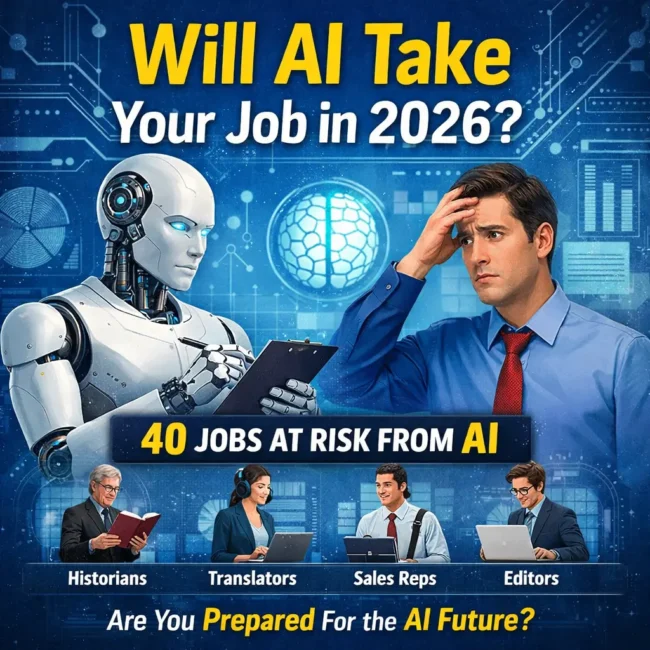
Microsoft recently released a list of 40 job roles with the highest overlap with AI, sparking global concern. Experts warn that these roles are at the highest risk of automation, although Microsoft clarifies that “high applicability does not mean jobs will disappear overnight.” Still, companies are increasingly turning to AI tools to boost productivity, often leading to hiring freezes or role cuts.
In this article, we break down the study, affected roles, and what it means for employees in India—especially in major tech hubs like Hyderabad.
Why Microsoft Conducted This AI Job Study
To understand where AI is being used most at work, Microsoft analysed:
200,000+ real workplace conversations
Interactions where employees used Microsoft Copilot
Tasks like email writing, meeting summaries, coding, data analysis, and strategy drafts
The goal was clear:
👉 Identify areas where AI assists workers and where it might replace a large share of human tasks.
The findings show that AI performs exceptionally well in:
Language-heavy work
Reasoning
Data analysis
Information processing
These happen to be core skills used in jobs such as writing, editing, programming, research, analysis, and customer service.
Which Jobs Are Most at Risk in 2026?
The study highlights that the most exposed jobs are those involving “knowledge work”—roles that are traditionally done in offices.
This includes people working in:
Computer & technical roles
Administrative work
Sales & communication
Research & reporting
Here is Microsoft’s list of the top 40 jobs most affected by generative AI:
Top 40 Jobs at Highest Risk Due to AI
Interpreters and Translators
Historians
Passenger Attendants
Sales Representatives (Services)
Writers and Authors
Customer Service Representatives
CNC Tool Programmers
Telephone Operators
Ticket Agents and Travel Clerks
Broadcast Announcers and Radio DJs
Brokerage Clerks
Farm and Home Management Educators
Telemarketers
Concierges
Political Scientists
News Analysts, Reporters, Journalists
Mathematicians
Technical Writers
Proofreaders and Copy Markers
Hosts and Hostesses
Editors
Business Teachers (Postsecondary)
Public Relations Specialists
Demonstrators and Product Promoters
Advertising Sales Agents
New Accounts Clerks
Statistical Assistants
Counter and Rental Clerks
Data Scientists
Personal Financial Advisors
Archivists
Economics Teachers (Postsecondary)
Web Developers
Management Analysts
Geographers
Models
Market Research Analysts
Public Safety Telecommunicators
Switchboard Operators
Library Science Teachers (Postsecondary)
10 Jobs Least Affected by AI
Some roles require physical, equipment-heavy, or on-ground tasks that AI currently cannot replace.
These jobs are the least affected:
Dredge Operators
Bridge and Lock Tenders
Water Treatment Plant and System Operators
Foundry Mold and Coremakers
Rail-Track Laying & Maintenance Equipment Operators
Pile Driver Operators
Floor Sanders & Finishers
Orderlies
Motorboat Operators
Logging Equipment Operators
These roles involve skills and hands-on activities that generative AI cannot perform without human supervision.
Will AI Replace Jobs in Hyderabad?
Hyderabad, being India’s fastest-growing tech hub, is heavily exposed to AI transformation—especially in:
IT services
BPO & customer support
Data analytics
SaaS startups
Digital marketing
Sales and CRM roles
With thousands of tech professionals using AI tools daily, some roles may evolve while others could shrink.
But here’s the important part:
AI won’t take your job—someone who uses AI efficiently will.
Professionals who learn to work with AI, rather than compete against it, will thrive.
How to Stay Relevant in 2026
Here are skills that will protect your career in the AI era:
1. Learn AI Tools (Copilot, ChatGPT, Gemini, Midjourney)
Basic AI knowledge is becoming as important as Excel once was.
2. Focus on Problem-Solving and Creativity
AI struggles with real-world judgment, leadership, and creative strategy.
3. Improve Domain Expertise
Industry-specific knowledge (healthcare, finance, logistics, etc.) is harder to automate.
4. Build Soft Skills
Communication, negotiation, and team leadership remain human strengths.
5. Upskill Continuously
Digital marketing, data analytics, automation, coding, and cybersecurity remain in high demand.
Final Verdict: Is Your Job Safe in 2026?
AI will not replace all jobs, but it will replace repetitive, text-heavy, and process-driven tasks.
Humans who master AI will replace those who don’t.
For Hyderabad’s young professionals and working-class employees, the key is simple:
👉 Adapt early, train continuously, and learn to use AI as a tool—not a threat.